Drilling the Shaft Hole in the Keel

Ready to drill!
Ready to drill!

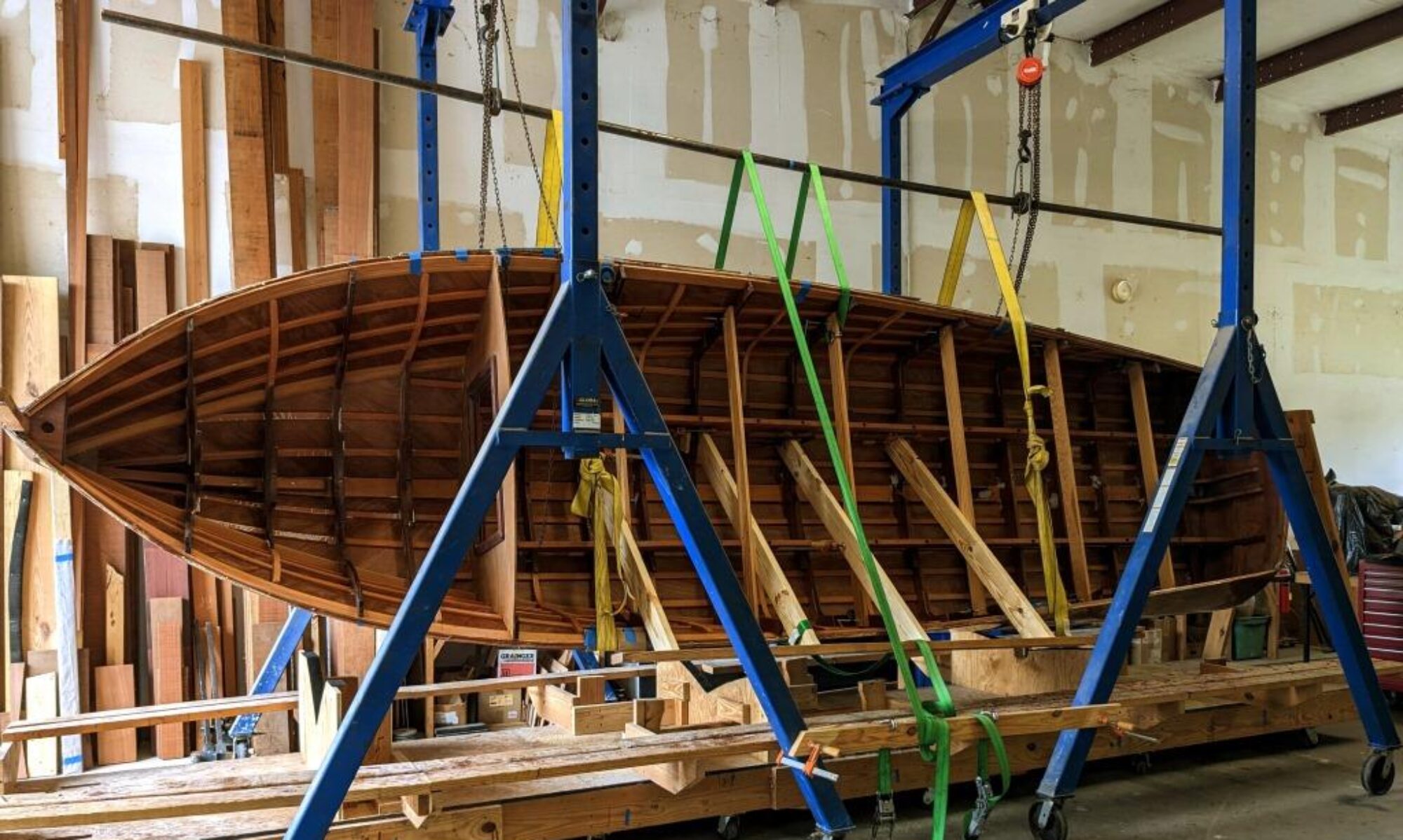
You can wait until the bottom is installed to drill the shaft hole and the rudder-post hole in the keel and line everything up.  But why not do it now, before the keel is permanently installed?  It is so much easier when you can bolt everything on to fit it without having to hop in and out of the boat 50 times.  OK, 50 times might be a bit of an exaggeration even for klutz like me, but it does take a few tries to make sure everything fits properly.  So I do it with the keel sitting off the boat so I can reach around all the pieces while I’m standing there.

You’ll recall we discussed Mounting the Strut a while back.   With that job done, you install the strut temporarily and use it as a guide to drill the shaft hole.  This is made easier by asking your shaft fabricator to make you a nice temporary bushing that will fit inside the cutlass bearing in the strut and guide your drill bit at the proper angle.  I use a drill bit extension and a 1-1/4″ forstner bit since the shaft has a 1″ diameter.

Blocks clamped on ensure clean entry and exit holes

Since this hole is at such a shallow angle to the keel (19°) I clamp a block at the point where the bit enters and exits the keel to make sure a clean entry and exit hole.  Then it’s just a matter of taking it slow and clearing the hole of sawdust often.  Don’t push too hard as you might cause the bit to drift off-line.  You might as well go slow and enjoy it since it took so long to set this up!

Inboard side of the keel with pocket for shaft log

Then flip it over and bore another, larger partial hole to create the pocket for the shaft log.


Mount everything up and check for proper clearances.

And then mount everything to make sure it lines up.  You’ll want to mount the rudder, strut, shaft, and the shaft log.  Of course there will be the inevitable cleanup with a wood rasp and round file, chisel, gouge–whatever your tool of choice is.

Once you’re satisfied, seal this hole well with 2-3 coats of epoxy.  This would be a great place for water to migrate into your keel and allow the growth of rot spore.

Repair the Transom

No, those aren't porcupine quills in the transom framing.
No, those aren’t porcupine quills in the transom framing.

No, the transom framing isn’t growing porcupine quills.  Look closer–they’re toothpicks.  Bear with me.  There’s a method to my madness.

If it seems like I’m procrastinating on planking the bottom, let me explain myself.  There’s really a lot to do before you cover up those frames that you need to clamp to.  And all those places that are so easy to get to when you can reach through the bottom will take a lot longer to deal with when that ready access is denied by a new bullet-proof bottom.  So get those frames and the underside of the deck painted while it’s easy!

Working with the transom is one of those things that’s easier done when you can reach through the bottom of the boat, so that’s what I’m working on now.  Of course the bottom plank of the transom was removed long ago so we could replace the lower transom bow.  I didn’t want to remover the other two planks until it was time to replace them because they help to hold the shape of the boat.  With the new bottom frames coated and now permanently glued in place, the boat is a whole lot stiffer and less likely to be pulled out of shape.  So let’s get cracking!

So what's that hole for?  It's not the fuel tank vent.  I don't really know....
So what’s that hole for? It’s not the fuel tank vent. I don’t really know….

First, why replace the transom planks at all?  Well, there’s a hole in the top plank that I can’t explain and can’t think of a good use for.  And the fact that the middle plank has been patched.  Add to that the prospect of matching stain on one new plank to two old ones, and it becomes easier to just replace all three planks.

So, removal begins with taking all the bungs out to access the screw heads and hoping most of the screws don’t break when I try to take them out.  In this case, I was pretty lucky (whew–not too much wailing and gnashing of teeth!).


I fill all the old screw holes with epoxy and toothpicks.

Did you know that when a wood screw is removed from its hole, it loses 85% of its holding power.  The screw threads cut into the wood fibers when you put it in the first time.  You simply can’t put it back in an old screw hole and expect it to hold nearly as well as it did the first time.  So I fill all the screw holes in the framework pieces that won’t be replaced.  I do this with epoxy and toothpicks, cutting them off flush after the epoxy cures.  Now I don’t have to worry about lining up or missing old screw holes, and it holds together much better.

Old framework.  I'll replace the two plank battens, but the cheeks and the stakes will stay.
Old framework. I’ll replace the two plank battens, but the cheeks and the stakes will stay.

Next step is to coat the framework with Smith’s CPES–that’s Clear Penetrating Epoxy Sealant.  It’s epoxy that’s been thinned to almost the consistency of water so it will soak in to the wood.  Really good stuff!  So good, in fact, that you have to wear a respirator with charcoal filters when you’re using it.  It’s best to plan this for the end of your day and just leave the shop afterwards.  This stuff is really strong-smelling.

Then time to cut out the new planks and steam bend them to the curve of the transom.  But we’ll save that for another day.

Mounting the Strut

Line up the strut with the keel temporarily mounted to the boat

Well, it’s time to start putting holes in the boat.  Now this is a subject any boatbuilder approaches with at least some degree of respect, if not downright fear and trepidation.  After all, you’re doing all this work to create something that floats, right?  But boats have to have holes in them to function.  You have to get water to the engine somehow.  The propeller shaft has to get from the engine inside the boat to the propeller outside the boat.  You have to vent the fuel tank.  You have to have a way to pump bilge water out.  The list goes on.

In this case, we need to mount the strut, which supports the propeller shaft, onto the keel.  We’ll then use the strut as a guide to bore a bigger hole–the one for the propeller shaft.  To make sure we get this right, a lot of attention gets paid to lining things up.  I install a new cutlass bearing in the strut and pass the old shaft through it.

Line up with the centerline and the string over the centerline

Then line this up with the center-line on the keel, and with the center-line string suspended over the boat.  Clamp it in place, and drill.

New Bottom Planks

New Bottom Plank Blanks clamped to frames

It’s not time to install them yet–that won’t come until after the inner layer of 1/8″ marine plywood is already fitted and installed.  But we need to bend the outer planks to the shape of the hull while we can still get to the frames to use them to clamp the planks to.  So now’s the time.  Boatbuilding, as with many other endeavors, is often not done in a straight line.  You do things when you can, when you have the extra help, when you need to.

The first step is to sort through the milled lumber and pick the nicest grain for parts that will show.  We allocated the pretty stuff to topsides planks, transom planks and ceiling.  That leaves the not-so-pretty stuff for the bottom, which will be covered with paint.

We’ll start with the garboard (that’s the plank that lies next to the keel, and incidentally, where a lot of leaky bottoms start) and work out way up toward the chine.

Having allocated our lumber, the next step is to cut out what I call the “blanks”.  I used the old planks (never throw anything away until the project is finished) as patterns to get the general shape of the new planks and cut them out big on with a jigsaw.

Now that last sentence could be a whole blog topic in itself.  I realize as I write this that there’s a lot of “how-to” that gets skipped over.  How big? Bigger on one edge than another? Is there one brand of jigsaw that’s better than another?  After all, the right tool really does make all the difference.  What about grain orientation?  Is there a problem with avoiding sapwood like when you’re cutting white oak?

I know there’s a lot that I gloss over here.  If you’re interested, you can always comment or ask a question.  I promise to answer.  And I promise to tell you if I don’t know.

Using old planks as a pattern to cut the new "plank blanks"
Using old planks as a pattern to cut the new “plank blanks”

Back to the main topic, I cut them out two at a time–one for each side of the boat, tracing around the old plank, leaving it 1/2″ big on the bottom and leaving about 3 to 6 inches on the aft end.  This way, if I make a mistake when fitting (which comes much later), I can slide the plank forward and re-do.


New Plank Blanks in the soaking box.

Then I presoak these mahogany planks for at least 24 hours before steaming them.  Mahogany, being less dense than white oak, needs less presoaking time.  I would soak white oak for a week or two before steaming.  Then it’s time to steam it.  In this case, since the planks are 1/2 inch thick, they’ll be steamed for at least 30 minutes.


All clamped up
All clamped up

Finally, pull them out of the steamer and quickly clamp them to the frames of the boat.  I only steam the forward planks.  The aft ones are pretty straight, and won’t be stressed by attaching them to the boat without steaming.  Having the forward ones curved to the shape of the hull greatly eases the task of fitting them, which is a topic for another day.

Cutting the Keel Rabbet

Using a router track to cut the keel rabbet.

We’ve already discussed cutting the rabbet on the stem and gripe here.  You can imagine that cutting this groove along the length of both sides of the keel with a hammer and chisel is a daunting task indeed.  Especially in a tough wood like white oak.  The procedure is complicated by the fact that the bevel changes along the length of the boat.  Just look at the way the bottom comes into the keel.

Steam bend pine planks to serve as a router track.

But thanks to Don Danenberg, there’s a better way.  He  devised a method of setting up a router track along the length of the keel and using the frames of the boat to get the right bevel.  It’s really clever, and saves a good bit of shop time, but requires that the frames all be fair before you start routing.

First, you steam bend a pine plank to lay alongside the keel.

Then screw it to the frames, and screw a 3/4″ x 3/4″ guide to the pine plank that your router will ride against.  The router sits on the plank and the keel, and cuts your rabbet.  It takes several passes because white oak is tough wood.  But it gets the job done accurately and in much less time than it would take to do it with a hammer and chisel.


Ready to route!
Ready to route!

I had some help from expert boatbuilder Mark Neely setting up this operation.  Thanks, Mark!


Using the Boat as a Form

Using the boat to steam bend intermediate frames

All this hard work getting the frames and other structural pieces into shape is finally paying off.  We can use this structural framework as a form when making and bending new pieces to fit the boat.  A good example is the Intermediate Frames.

View from the stern
View from the stern

Intermediate frames are the sticks that go between the main and auxiliary frames to provide another fastening point for the bottom planks.  We made these out of 5/8″ x 1″ pieces of white oak.  We steamed them for about an hour–probably could have gone a bit longer–they were hard to bend!  Then, as you can see, we just bent them under a batten clamped down the center of the frames to give them the curve they’ll need in the area of the boat they’ll be used.  Keep in mind that you’re seeing parts for both the port and starboard sides of the bottom here, clamped on place on the starboard side only.  But since the bottom is symmetrical, we can use one side for both.

Bench form for smaller pieces

For these small forward pieces it was easier to just make a simple form on the bench.

A New Stem and Gripe

Fitting the new Stem and Gripe blanks

The Stem and Gripe together make the Forefoot of the boat.  This is the curved part of the bottom that provides the transition from the stem to the keel.  It needs to be a formidable piece of the boat because it is the piece that parts the water as the boat makes its way.  It takes considerable pounding, and in an older boat, almost always has some rot in it.  That means it’s going to have to be replaced.

Since we have the plans, we could loft the boat and then take off the curves to make a new stem/gripe.  But we have a pretty good pattern (albeit with a little rot here and there) in the old one.  Using a sheet of glass and some clear plastic from the art store, we can draw out a pattern and transfer that to properly dimensioned white oak to make a new one that’s better than the old–better because it’s made of rot-resistant white oak.

Using the old stem/gripe to make a pattern

So the first step is to lay a piece of 1/4″ glass over the old part and trace its lines onto a piece of clear mylar.  Of course you want to get as much information as you can on this tracing, including bolt locations, bootstripe, etc.  And make sure you are looking straight down on the part when tracing to avoid any parallax error.

Avoiding the lighter colored sapwood when laying out the new pieces.

Then take your new pattern and transfer the lines to your new wood.  You do this by tracing over the new mylar pattern with a “pounce wheel”, which you also get at your friendly art supply store.  You can see in our example that we made sure to avoid any sapwood in the new pieces.  Sapwood is much lighter in color and contains dried sap and sugars.  Including sapwood in your boat is like a flashing neon sign for rot spore–bad news if you want to keep your boat rot free.

Once the pieces were cut on the bandsaw, it took a little time to fit the joint between the stem and the gripe.  You need a good, solid joint here that, once slathered with bedding compound, will not allow ingress of any water.

Clamped stem and gripe.  Checking the overall curve of the piece and fitting to the breasthook.
Clamped stem and gripe. Checking the overall curve of the piece and fitting to the breasthook.

Once we got that joint in good shape, the stem and gripe blanks were bolted together and fit to the breasthook.  Then it was time to look at the curve of the whole assembly and make sure it would be fair with the keel joint.  As you can see, we had to glue in a shim or two, but there’s no shame in that.


Grab your chisel, follow the lines from your pattern, and have at it!

Finally it was time to carve the rabbet.  That’s the groove that runs lengthwise along the piece for the bottom planks to rest in.  That’s really a topic all in itself, but we’ll show it here.  To make a long story short, you use the lines you’ve traced on to your blank from the old stem/gripe assembly.  Using those lines, you have at it with your chisel and carve out the rabbet.  It helps to have a test stick, called a “fid”, that is the same thickness your planking will be to test how it fits in the groove as you carve it.  With a tough wood like white oak, you have to pause a few times to sharpen the chisel.  You can definitely tell the difference a sharp tool makes here.

Finished rabbet (on this side, at least).

Then clean it up with a plane, sander, Fein multimaster, whatever works.  You’re done!

Steam Bending Parts

I used a piece of pvc pipe as my steambox for the lower transom bow since it was a short piece.

A lot of preparation is required for steam bending wood.  You need a fair amount of specialized equipment.  I covered that a couple of weeks ago here in Getting Ready for Steam Bending Wood.  Now it’s time to put that equipment into action.

The first piece I bent was the lower transom bow.  I chose it because it was short, and I figured it would be easy to handle without the help of another person.  You have to get the piece out of the steamer and onto the form quickly, before it cools.  So if it’s long or cumbersome, it helps to have more than one person.

8 ft. radius form for bending transom pieces

This boat has a curved transom with an 8 ft. radius to the curve.  There aren’t enough pieces in the actual transom framing to support a smooth, even clamping surface, so I had to build a form.  For everything else, we can use the boat framework as our form (i.e. keel, chines, planks).


Lower transom bow that was steamed and clamped to the form.

Here’s the lower transom bow clamped to the form.  I tried 3 times to bend a piece I could use.  But alas, because the oak was about 1-1/2 inches thick, and because the bend was so severe, I got too much springback.  The bent piece could be clamped to the boat framing, and forced to the proper shape, but this isn’t really what you want.  Particularly with the transom, you want the bow to describe the curve and hold that curve.  Forcing a piece to a tighter curve here runs the risk of having the bow stress some of the joints and pull them apart.  I guess that’s why the original transom bow was sawed on a curve.

I didn’t like the idea of sawing this piece on a curve.  It gives you too much short grain at the ends of the curve, which can split.  Of course, it worked for 60 years.  We have the original transom bow to prove it.  But there’s a better way.  I finally chose to laminate oak strips to the correct curve, using the form I’ve already built.  I’ll post some pictures of the laminated transom bow later.

Dave and James holding Sadie the Wonderdog.  Lisa (standing) and Annie (down in front).
Dave and James holding Sadie the Wonderdog. Lisa (standing) and Annie (down in front).

For now, it was time to move ahead and bend in the keel and chines.  I was able to use the framework of the boat for my form for these pieces.  They’re much longer (they run the whole length of the boat), and you need two people to get them out of the steamer and onto the boat quickly.  So I enlisted the help of some good friends.  This picture is of the crew that helped with the starboard chine.


2013-10-16_17-56-05_46 chine steam bent onto boat frameFinally, after the chine was bent onto the boat frame, it was wrapped in wet towels to let it cool and dry slowly–over several days.  Here’s a picture of it without all the people in the way.  Not much to see really.  But it’s there under the rags.


Making New Frames

Using the old frame as a pattern

After stripping the bottom planking off (see Remove the Bottom), it’s a good time to take another look at the soundness of the bottom framing.  Now you can see it from it’s most vulnerable angle–the joint between the frame and the bottom planking.  This is where water is most likely to collect (the bottom of the bilge) and be absorbed into any unsealed wood.  Remember, any wood with over 20% moisture content is a great place for rot spore to grow.   The factory may or may not have sealed this joint with paint, but that was 60 years ago.

After taking another look at the bottom framing, it’s in pretty good shape for being 60 years old, but still, it is 60 year old wood.  It leaks around the transom joint, and is oil-soaked under the engine.  We’re going to be putting a newly rebuilt engine in this boat and it is, after  all a speedboat.  You wouldn’t put a new engine in a 60 year old car without addressing the chassis.  It would soon shake apart.

Aside from all that,  the original bottom frames are made of  Philippine Mahogany–a wood with little to no rot resistance.  We’ll replace them with white oak which is a traditional boatbuilding wood because of it’s good fastener-holding and rot resistance properties.

New frames being fit in with old

We’ll use the old frames as patterns to cut out new ones.  Then we’ll  install each new frame, using the old keel and chines to get the lines right, along with battens, and bevel the new frame in place.


Fairing the keel landing forward

Finally, disassemble the whole thing, seal the new frames properly, and permanently install them.  This gets the new frames sealed at the joint surfaces–a very important step that keeps them from soaking up moisture where you can’t see it.

Remove the Chines and First Topsides Strake

The Chine is the piece that defines the "corner" between the topsides and the bottom of the boat.
The Chine is the piece that defines the “corner” between the topsides and the bottom of the boat.

So we’ve got the bottom off (see Remove the Bottom), what now? Well let’s take a moment to look at the chines (the longitudinal piece of lumber that creates the “corner” between the topsides and the bottom).  While we’re at it, we’ll take a look at the keel as well.  These pieces are made of white oak, so that’s good material.  But they’re also 60 years old, and very perforated.  The keel is oil-soaked under the engine, which weakens wood considerably.  It also has a bad dip in it forward, with no good way to smooth that out.  Once you’ve come this far, you’d be crazy not to replace these pieces.  So off they come.

In order to get the chines off, you have to remove the first topsides strake (plank) next to the chines.

Tape off the area to be stripped and slap on the stripper.

The first step in removing the topsides strake is to strip the varnish off it to make removal of the bungs easier.

Stripping the old bottom paint reveals a low spot in the old plank faired out with compound.

We haven’t made a decision yet on whether to replace this plank, so to avoid splintering around the bung holes when removing bungs, we strip the finish which acts as a glue and can pull splinters of this delicate old wood.


Remove bungs by stabbing them with an ice pick.


Once the finish is stripped, the bungs can be removed by splitting them with an ice pick, and pulling the pieces out carefully.  This exposes the screw heads which you can carefully back out, trying not to catch on the side of the bung holes and splintering the wood.  You will inevitably break some screws and find some already broken.  Mark them for later drilling and extraction.

Close up of bung being removed.

After you’ve got the planks removed on both sides of the chine, it’s a pretty simple matter to unfasten the chine and remove it.  Broken fasteners holding the chine in shouldn’t present too much of a problem since we’re replacing the chines and the bottom frames.