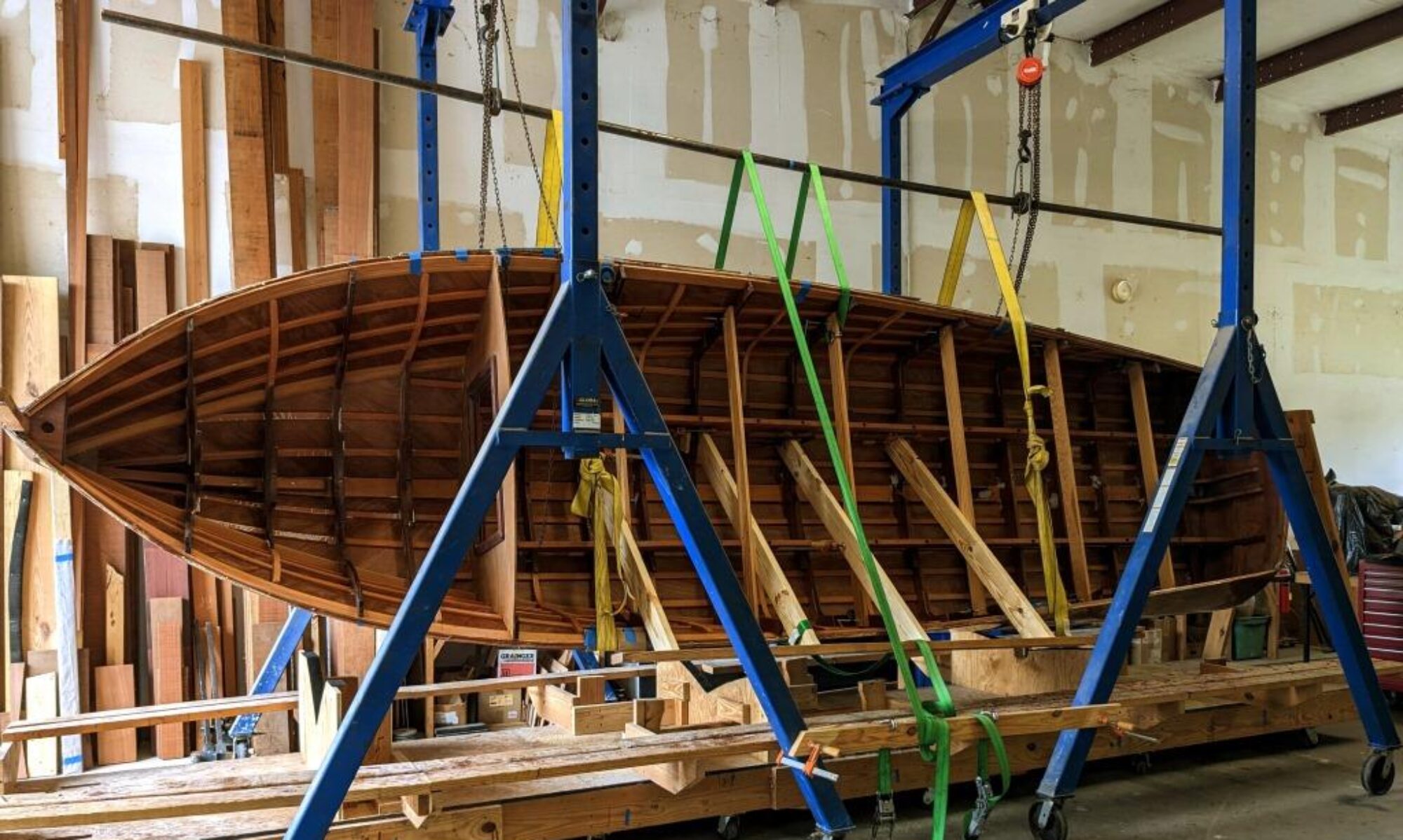
New Gunwales

The graceful sweeping curves of the new inwales clearly show the need for steam to bend them into place.

Gunwale is an old nautical term.  A wale is a plank on the side of a ship or boat.  The top wale on a sailing warship was called the gun wale and was reinforced to carry the stresses imposed by heavy cannon.  Typical of nautical terms, it is not pronounced like it is spelled.  “Gunnel” is the correct pronunciation.  In canoes, it has come to mean the reinforcing strips along the top edge of the boat.  Specifically, there are usually two strips, an inwale and an outwale. Continue reading “New Gunwales”

Building a Half Hull Model

Finished half hull model of the Palm Beach 22

In days of old boatbuilders would carve out a half hull model and show it to the client.  Once everyone agreed on the shape, the builder would take the lines off the model, loft it (see discussion of lofting here), and build the boat.  The half hull model was the starting point.  Nowadays, we have the lines already on paper, and we can use that to build a half hull model to represent the design of the boat in 3D.  Actually, we can model it in 3D on computers now, but sometimes one wants to do things the old-fashioned way. Continue reading “Building a Half Hull Model”

Lofting the Palm Beach 22

Mack Brown helps with lofting the lines of the Palm Beach 22
Mack Brown helps with lofting the lines of the Palm Beach 22.  Look closely and you can see the curves of the boat!

So, we’ve decided on boat plans and purchased them.  We’ve detailed the lumber we’ll need and ordered it.  Now it’s time to draw the boat’s lines full scale.  That means we’ll end up with a 22 foot long drawing of the boat, since the boat will in fact be 22 feet long.  As a friend of mine in the construction industry used to say, we’re going to draw it at a scale of 12 inches to the foot.  The process is called lofting, because the only place big enough to do this in boat shops of old was the sail loft. Continue reading “Lofting the Palm Beach 22”

Sea trials of the 1949 Chris Craft Deluxe Runabout

1949 Chris Craft Deluxe Runabout floats level and true
Dereck helped with driving the boat. He was the fastest, reaching 31 mph.

Finally! Sea trials are here!

Click here to see a short video of the sea trial.

Eventually, a boat ends up in the water.  There are lots of things to check when that happens.  Does it float?  Does it float level?  Does it float anywhere near the design waterline?  Does the engine run?  Does it steer properly? etc. etc. Continue reading “Sea trials of the 1949 Chris Craft Deluxe Runabout”

Adding the Shiny Parts

Stainless Steel cutwater
Adding the stainless steel cutwater and rub rails really add the finishing touches.

Chrome and highly polished stainless steel are beautiful things on a Chris Craft.  They really make the boat pop.  Don’t cheap-out on your re-chroming.  There aren’t a lot of chrome shops left in the U.S.  It’s a nasty, dirty process that takes a craftsman’s eye and touch to do right.  It’s expensive, but if you want it to last, you’ve got to pay for it.

Stainless is a little easier.  It’s not terribly expensive yet, and often it’s easier to replace than to try to refurbish.  But if it’s not deformed, a buffing wheel and a little elbow grease can go a long way to making some old stainless look better. Continue reading “Adding the Shiny Parts”

Connecting the Exhaust Pipe

The exhaust pipe to exhaust elbow can be problematic because of heat and water.

Connecting the exhaust pipe to the exhaust elbow can be problematic for a couple of reasons:  it gets hot and it gets wet.  Oh yeah, and it needs to be air tight so you don’t end up leaking exhaust into the boat. Continue reading “Connecting the Exhaust Pipe”

Caulking the Deck Seams

I use Sikaflex 291 LOT to caulk the deck seams.

After the varnish is laid on, but before the final coat, it’s time to caulk the deck seams.  Most of them (2 out of 3) are false seams–only there for show.  But every third one is live.  It is essential to get a good seal with the seam caulking to prevent leaks and rot.   Continue reading “Caulking the Deck Seams”

Varnishing the 1949 Chris Craft 17 ft Deluxe Runabout

Stern view after 3 coats of conventional varnish

Staining is just preparation for varnishing.  We talked about staining recently here.  Now it’s time for a bit of strategizing.  We’re anticipating about 6 coats of conventional varnish (Interlux Schooner 96) and then about 8-10 coats of AwlWood MA Gloss over that.  When you’re talking about that many coats, spraying is the way to go. Continue reading “Varnishing the 1949 Chris Craft 17 ft Deluxe Runabout”

Staining the boat

Applying filler stain to the 1949 Chris Craft 17 ft. Deluxe Runabout

With all the interior work finished, it’s time to focus on the pretty part.  It’s time to finish stripping the hull, repair holes and dings, and stain the hull.  All this precedes the varnishing phase.  I use the most aggressive chemical stripper I can find (Jasco brand) and let it do the work for me.  I slap it on liberally and let it sit there awhile and eat away the old varnish.  You can actually hear and see it doing this if you watch closely. Continue reading “Staining the boat”

Installing the K Engine

Here's the engine ready to be lowered away to its new home.
Here’s the engine ready to be lowered away to its new home.

It was finally time to put the engine back in to this boat.  Check out the post on rebuilding it and running it.  Also, Chris Craft didn’t install oil filters on these engines.  Can you believe it?  Well we did, and here’s our discussion of it. Continue reading “Installing the K Engine”