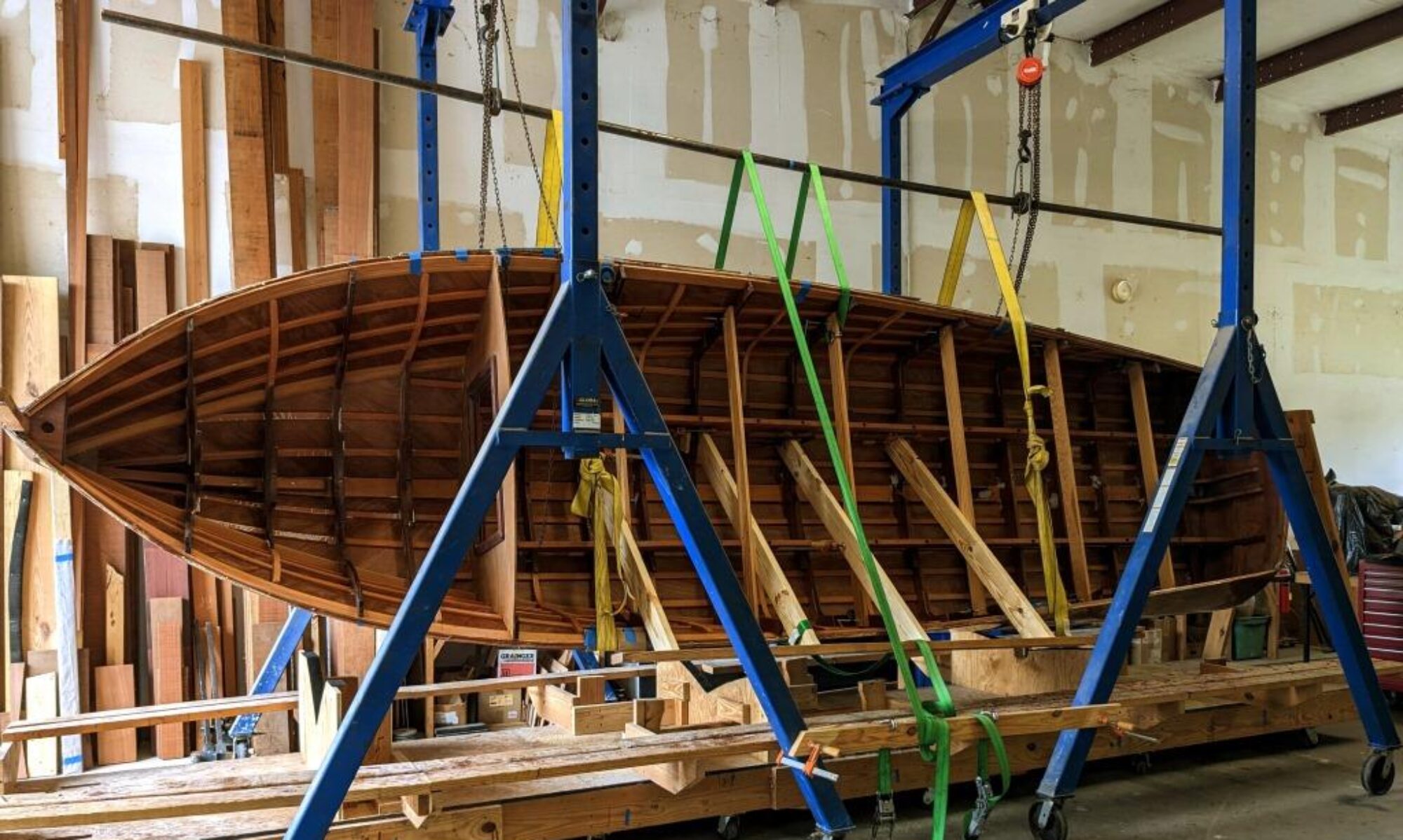


It’s time to start working on the deck. And the first step is to make the deck beams. You might think the shape of the deck beams is a simple curve that’s given to you in the plans, and you’d be right–kind of. You’re given the curve of the deck in the profile view in the lines drawing, and from that you can derive the deck beams curves using your lofting. You might be surprised to find out that the deck beams aren’t all the same radius curve (“camber”). Most of them are very close. But they tend to be a little different forward and aft. Boats just seem to look better when the deck camber (curve of the deck) is a little steeper forward.

I decided to laminate my deck beams from Sitka spruce strips. Because the grain in a laminated beam follows the curve of the beam, they’re considerably stronger than sawn beams. I laminated enough blanks for all the beams using the curve for station 3 where there is a bulkhead. Then I’ll cut the exact curves to the blanks for each individual station and half station.

So I worked out these various curves from the lofting of the deck line using a spreadsheet and the math for the chord of a circle. I then cut patterns out of 3/16 inch plywood for each deck beam so I could fit the angles at the beam ends. It’s so much easier to shape a piece of 3/16 plywood and then use the pattern to cut out your final deck beams. You can see in the accompanying picture how the angle at the end of the beam, as well as the exact length can be calibrated for a good fit. You still have to “sneak up on it”. But if you completely mess it up, it’s easy and much less expensive to start over with a new piece of ply.

What you can’t get from your 3/16 pattern is the bevel angle on the end of the 3/4″ thick beam, or the bevel of the top edge. Start with some beams in the middle of the boat. Though the beams themselves are longer, the angles and bevels are more straightforward there. They get trickier when you get close to the bow. But once you get your system down, those aren’t too difficult. Still and all, these compound bevels and angles are tricky. Take your time to get a good fit. Your boat will be much stronger for it.

Finally, a good limber batten will help you gauge fairness of the deck camber as you’re fitting the beams. Don’t get impatient and steamroll ahead until you’re satisfied that you can’t do any better. It’s easier to take a little off the curve of a 3/4″ beam than it is to plane down (or fill) a whole section of your deck after you’ve glued the beams in place.
Fair winds until next time!