Deck Beams for the PB22

Using 3/16″ plywood to pattern the deck beams

It’s time to start working on the deck.  And the first step is to make the deck beams.  You might think the shape of the deck beams is a simple curve that’s given to you in the plans, and you’d be right–kind of.  You’re given the curve of the deck in the profile view in the lines drawing, and from that you can derive the deck beams curves using your lofting.  You might be surprised to find out that the deck beams aren’t all the same radius curve (“camber”).  Most of them are very close.  But they tend to be a little different forward and aft.  Boats just seem to look better when the deck camber (curve of the deck) is a little steeper forward. Continue reading “Deck Beams for the PB22”

Developing the Sheer Line

A sweet and fair line is what you’re after when developing the sheer line.

One of the most critical steps in building a boat is to develop a fair sheer line and trim the hull to that line.  The sheer line is the line where the hull joins the deck.  It’s probably the most scrutinized line on the boat.  It’s what everyone notices. Continue reading “Developing the Sheer Line”

Fitting the Mechanicals on the PB22

With sole pieces in place, it’s easy to check the fit of hoses, battery boxes, etc.
Here’s a look at some of the sole pieces I talked about patterning in an earlier post.

I’m trying to get ready to coat the inside of the boat before I begin construction of the deck.  It’ll be much easier this way with an open boat to work in.  But before I can do the coating (clear coating on the sides and white paint in the bilge), I need to make sure all the pieces that make the boat go will fit.  In the process, I’ll drill some more holes, glue in backing blocks, fabricate platforms, etc.  As usual, what seems like a straightforward process requires many steps. Continue reading “Fitting the Mechanicals on the PB22”

The Strut, Shaft, and Shaft Log

Getting the engine in the proper position requires a lot of test fitting to establish location of engine beds and all the other items.

When you’re building an inboard boat, getting the engine and propeller shaft in perfect alignment is an interesting process.  It’s a logical process that involves aligning the engine and transmission, shaft, shaft log, and strut.  It starts with the strut (the piece that holds the shaft in place just forward of the propeller).  There is a tube the shaft passes through that gets glued into a hole bored through the keel.  Getting that tube, called the shaft log, glued in line with the shaft and engine is the aim of this process. Continue reading “The Strut, Shaft, and Shaft Log”

Adding a Fresh Water Cooling System

Canadian Runabout
A 1957 Greavette, a Canadian built runabout.

Boat motors use the water they’re floating in to cool them.  Some, like most outboards, have what’s called a “raw water” system.  The water the boat is floating in circulates through the engine block, then exits with the exhaust.  Most modern inboards have a “fresh water” or “indirect” cooling system.  In this system, coolant like that in your automobile is pumped through a heat exchanger.  The coolant is circulated through the engine block rather than the raw water itself. Continue reading “Adding a Fresh Water Cooling System”

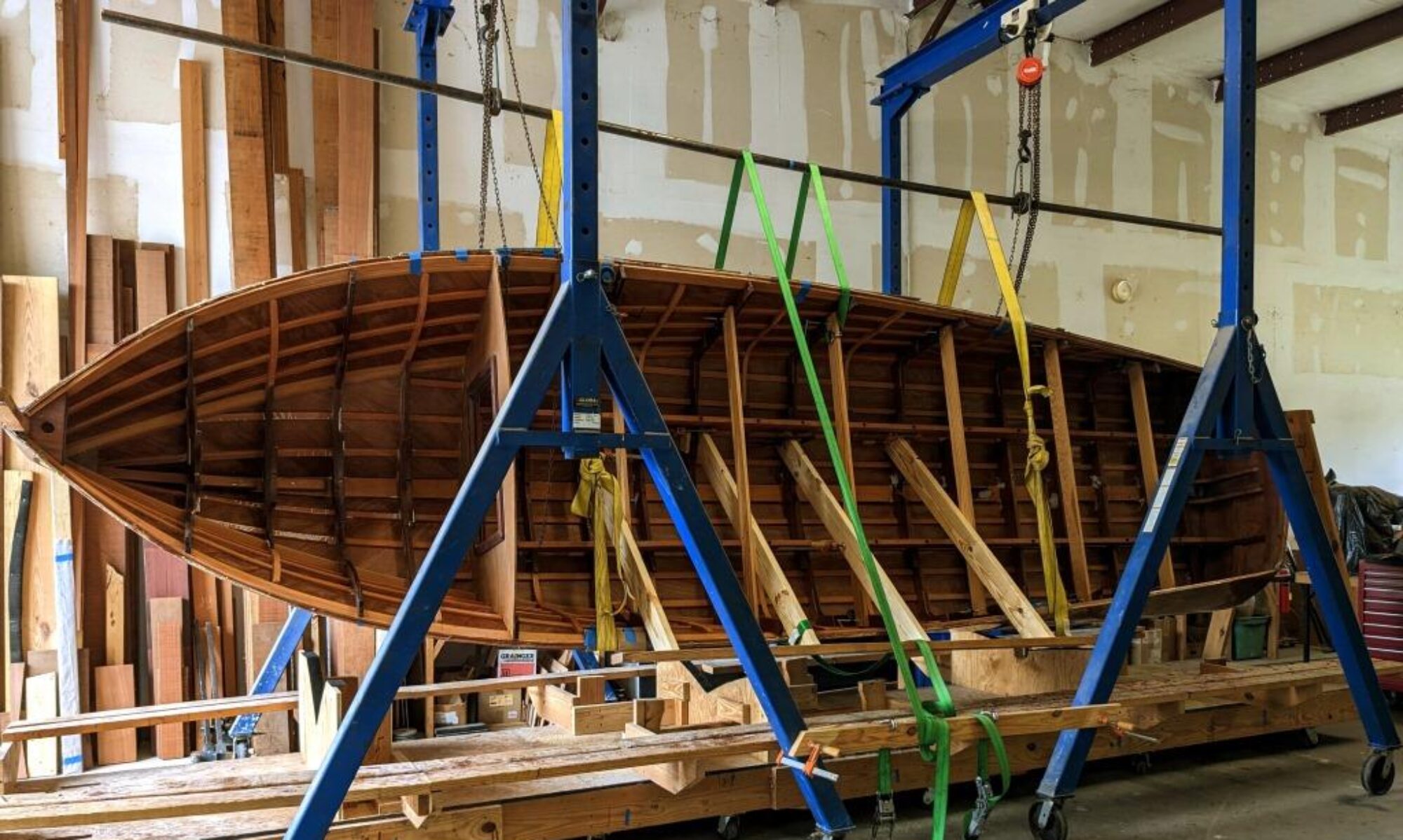
Flipping the Boat

The boat is at rest in a sideways position. Notice the cradles under it ready to receive it.

I’ve done all I can to the hull from the outside.  So it’s time to flip the boat upright so I can start working from the inside.  To prepare for this, I’ve made 3 cradles to hold the boat in position once its upright.  I used the patterns for some of the frames with one placed directly under where the engine will be mounted.  Using the waterlines on the patterns, I was able to set up the cradles so the boat will sit level and plumb. Continue reading “Flipping the Boat”

Bummer Dude!–Redoing the Topsides Again

Fiberglass print through
You can see the fiberglass print through here. I’ll have to take a class in this to learn how to get it right.

I never did get the fiberglass to work to my satisfaction on the topsides.  I tried again with smaller batches in cooler weather, but still got the fiberglass veil I spoke of in my earlier post.  So I stripped it off again, decided not to stain the boat but just let the natural woodgrain show, and moved on.

A man’s got to know his limitations.
                                                                                           –Dirty Harry


Fiberglass Setback

Peeling fiberglass off wooden boat
Peeling 6 oz. fiberglass cloth off the boat with a heat gun

I have not failed.  I have just found 10,000 ways that won’t work.                 — Thomas Edison

Adding a layer of fiberglass cloth to any wooden boat will add an enormous amount of toughness to it.  And if you do it right, the fiberglass is invisible.  That’s right — invisible.  The problem is in the “doing it right” part.

Okay, let’s step back a bit. Continue reading “Fiberglass Setback”

Cutting the Flat

You can see the exposed end grain in this picture of the flat cut most of the way with a power plane.

Last time, I talked a little about cutting the flat along the keel so I could put a cap over it to keep from having exposed end grain there.  My friend Steve asks, “Well, exactly how did you do that?” (or words to that effect).  It did, in fact, take a little bit of doing.  So I decided to explain myself a little better in a follow-up post. Continue reading “Cutting the Flat”

Steaming the Bottom Plank Blanks

Here’s a good look at the steaming bag and the clamps I used to hold the blank in place while steaming and then cooling.

The twist in the bottom planks at the bow is pretty extreme.  When it becomes impractical to clamp enough twist or curve into a plank to fit it properly, it helps to be able to get it closer to the final shape before you pop a blood vessel in the struggle. Continue reading “Steaming the Bottom Plank Blanks”