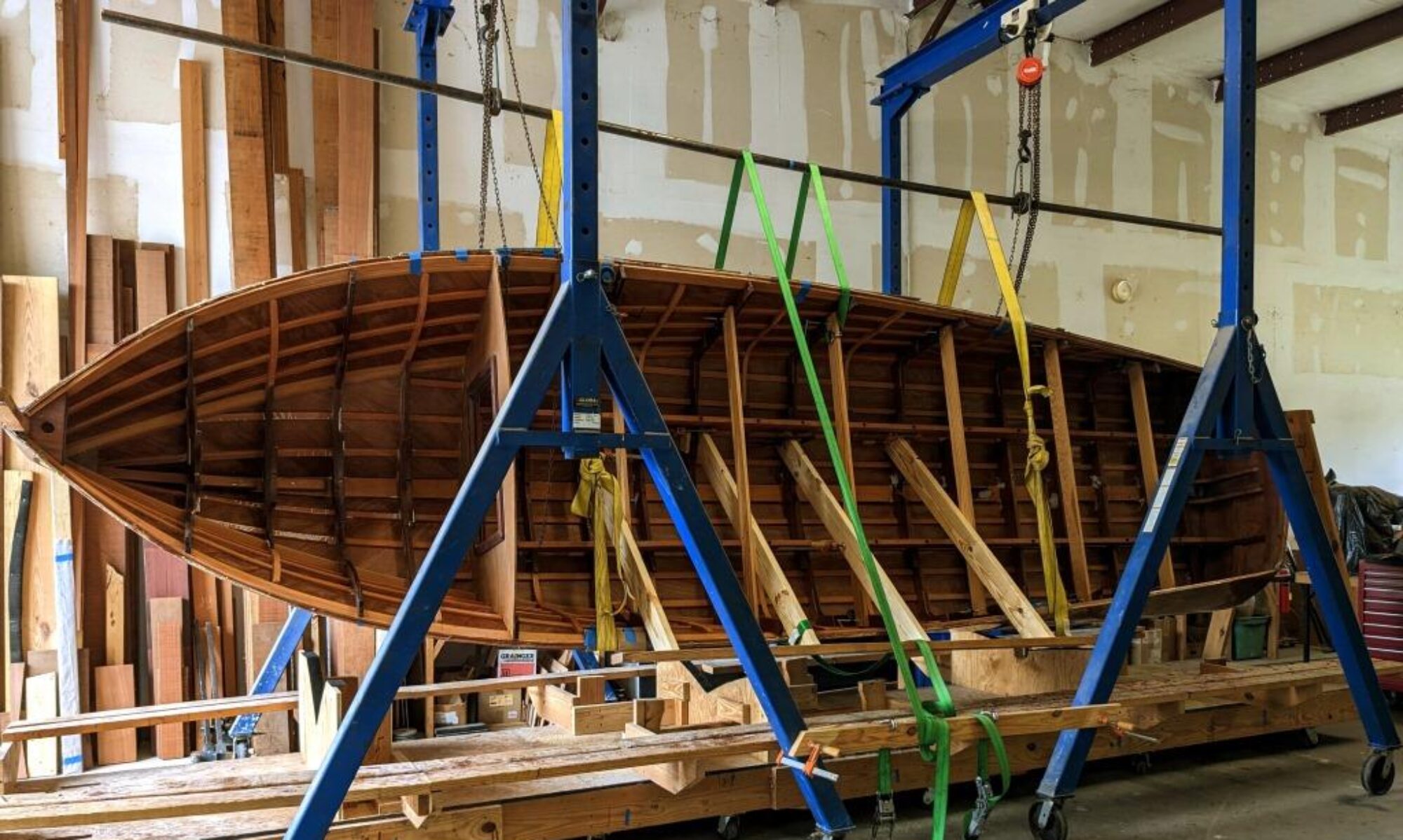
Once the boat is stripped of as much weight as possible (seats, ceiling, floorboards, engine, instruments, dashboard, rudder, fuel tank, other miscellaneous hardware), it’s time to roll it over. Much of the work will be done with the boat upside down. So you’ve got to figure out a way to get this thing upside down without damaging it.
Of course there’s always the “15 Friends and a Mattress” technique. But I don’t have 15 friends that will agree to show up at the same time to roll a boat over. And boats are made to be slick and smooth so they can mover through the water. This makes them difficult to hold on to, particularly when you’re trying not to drop it! I decided to employ the much safer method of using 2 gantry cranes and an iron pipe.

The first step was to make a rack to put the flipped boat on. It’s a good idea to put casters on the rack, so you can easily move it around your shop.


Next, I suspended the boat by 2 four-inch load straps that were tied over a 2 inch black iron pipe suspended in a couple of bearing assemblies that my friends at a local machine shop fabricated for me. The idea is that the pipe with the load straps will rotate in place, allowing you to roll the boat over while it’s hanging from the straps.
Next, I had to lower the boat and re-tie my load straps so I could raise the boat high enough to roll my rack up under it.
Then lower the boat onto the rack. The cross-spalls on the rack were set at the right height so that when the top of the stringers were set down on them, the boat was level and plumb. This is the kind of thing you can only pre-plan if you have a copy of the lines drawings. See the previous post entitled “Plans”.
Then it was a simple matter to roll the rack into place on the shop floor. Then the rack was blocked up to make it level and plumb.
Special thanks to Morgan Houtz who helped with the roll over, and Sadie the Wonderdog, who helps with everything.


 The current project for Ashley River Boatworks is a 1949 Chris Craft 17 ft. Deluxe Runabout. This boat will receive a new bottom, upholstery, cockpit ceiling, and engine rebuild, and be completely refinished. It’s a long road, starting with a lot of research and investigation into how it was done originally at the factory. A good resource for this is the national Mariners Museum in Newport News, VA. They have an extensive archive of Chris Craft drawings, literature and marketing material. The original lines drawings were available for this project from the museum. I’ve actually been working on this boat for some time, and will be trying to catch up with posts on progress that has been made. By the way, did you notice anything funny about that bow light?